 KHNUM FORGE
KHNUM FORGE
KHNUM FORGE
Built first for the general counsel's office: contracts worked end to end in one governed workspace, obligations that never slip, and a legal line your whole company can ask.
Tyr is Khnum Forge's digital legal team. This page shows the in-house practice first — the contract desk your legal department actually works in every day, and the internal counsel line behind it — then the other kinds of law Tyr serves, and why the work can be trusted: the parts that must be right are checked by code, and accountable decisions stay human.
Most "legal AI" reads documents and writes summaries. A legal department needs more than that: it needs the matter worked the way an experienced practitioner works it — the governing law understood, the document held against the actual standard, the position built, and every assertion tied back to its source. That domain knowledge is built into Tyr, not something your team has to prompt out of a blank model.
Named for the Norse god of justice and lawful order, Tyr is a vertical — a purpose-built legal team, distinct from the general-purpose personas. He arrives with the foundational, public legal knowledge a freshly graduated law student carries — due process, administrative and procedural law, the standards of review, evidence, and the professional-responsibility / UPL limits every matter runs under. On top of that, the Tyr your organization runs is fitted to your practice: the law of the jurisdictions you operate in, guided by your own policies and playbook.
This is the flagship of the in-house practice: one place where a draft is born, negotiated, and kept — with every version, every edit, and every decision attributed and preserved. Tyr does the drafting whenever you want a first version, and the initial review, every time — counsel starts from a graded redline, never from a blank page. No document ever leaves the record; "without track changes" means an unmarked display, never an unrecorded edit.
Need a first version? Tyr drafts it from your playbook and standards. Working the counterparty's paper instead? Bring it in as-is, by .docx upload or pasted text — a file that arrives with tracked changes is read as-proposed, and the original is stored as the formatting system of record.
Every version that enters gets Tyr's review before it costs counsel a minute: he computes the exact redline against your last version and grades each change against your playbook. You accept, counter, or reject — each decision recorded under your name — and Tyr composes the counter-version from your decisions.
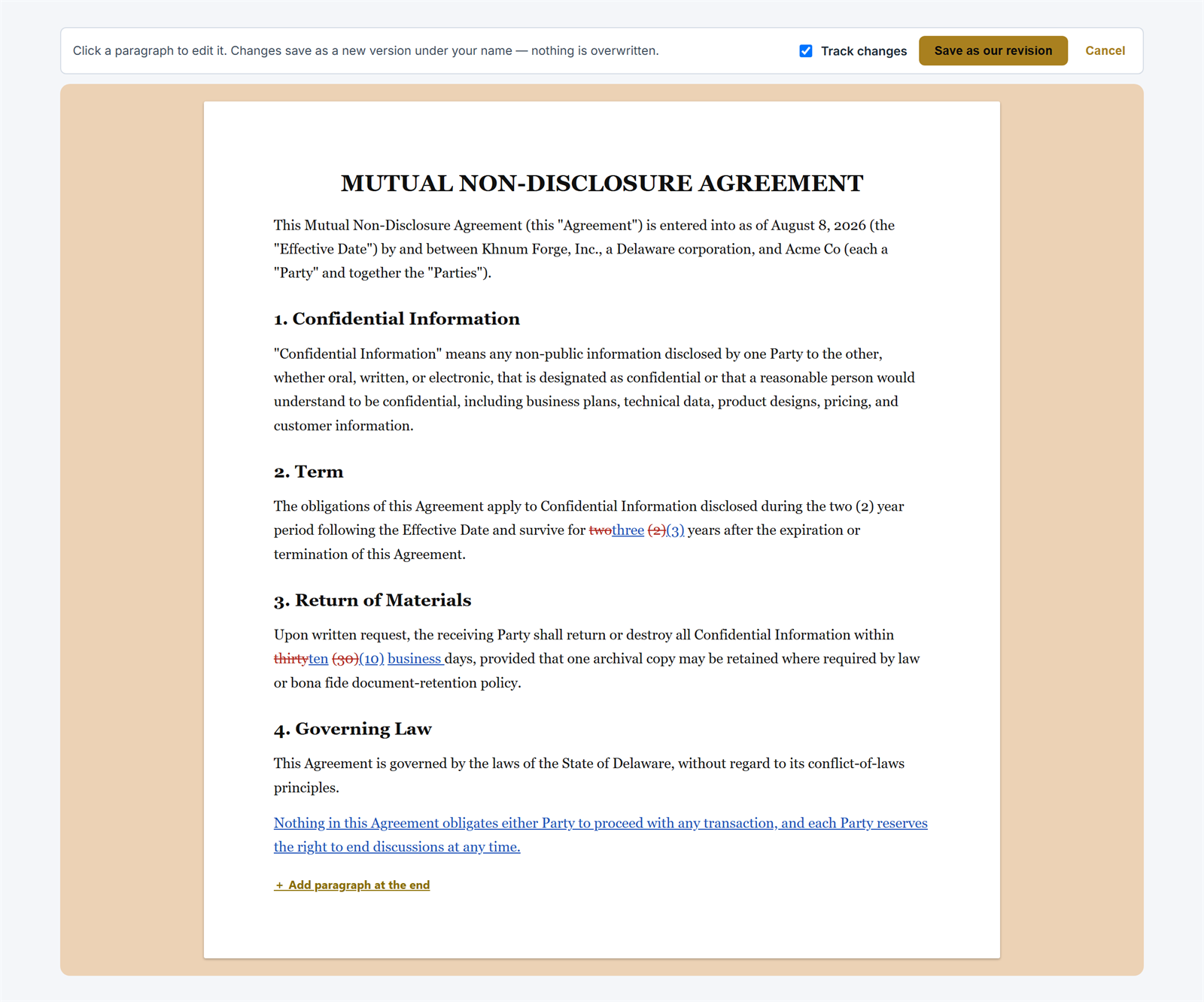
Click a paragraph and type. A track-changes toggle shows your edits as live marks — or clean text — and saving records a new, attributed version. Nothing is ever overwritten.
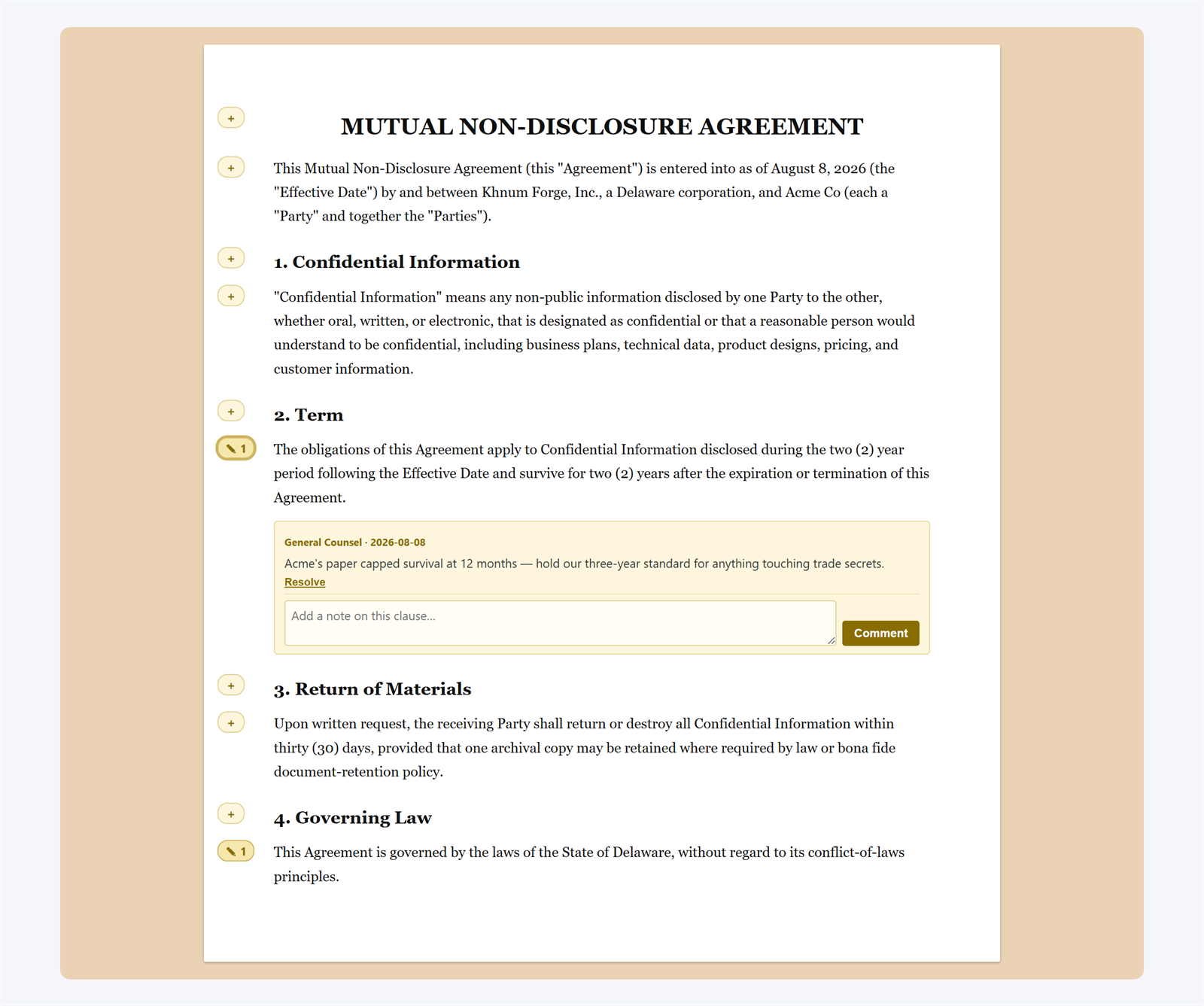
Notes anchor to the clause they're about, carry the author and date, and are resolvable — never deleted. Open notes ride along as real Word comments when the document is exported.
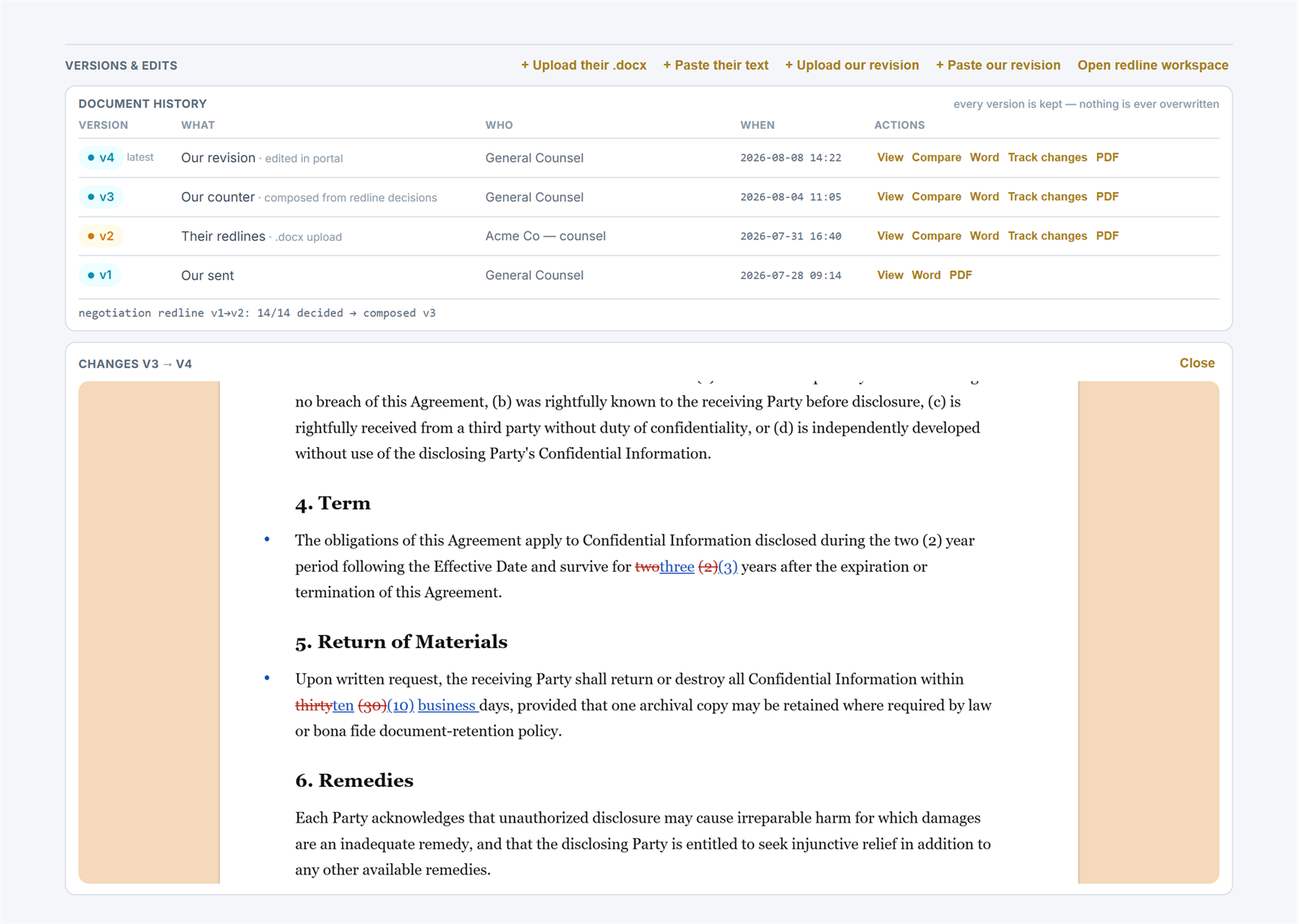
Every version of the paper — who made it, when, and how it entered — with per-version view, compare, and downloads: clean .docx, a tracked-changes .docx marked against its predecessor, PDF, and Word.
Signed paper lands in the agreement registry, faceted by counterparty and kind — and renewal windows, notice periods, and other obligations feed a lifecycle calendar so nothing quietly lapses. CLM isn't a separate product to buy and integrate; it's where the desk ends every deal.
Most questions that reach a legal department aren't matters — they're questions. Ask Tyr is the self-serve line for your company's people: can I sign this? what does our policy say? do we have an NDA with them? The answers carry your policies and playbook behind them, anything that needs judgment routes to counsel instead of being guessed at, and the legal team sees what's being asked — a running map of where the business needs law.
For a general counsel, the sharpest line in the budget is the routine, planned work that leaves the building: the per-filing invoices, the annual policy refreshes, the questions your own playbook already answers. That work is predictable — which is exactly what makes it insourceable. Tyr augments your legal team so the planned work stays in-house, worked to your playbook on your calendar, and outside counsel is reserved for the matters that genuinely need them.
Registrations, qualifications, and compliance filings across every jurisdiction you operate in — tracked, prepared, and calendared in-house.
Insourced: recurring per-filing work that repeats every year stops going out at hourly rates.
Entity governance cycles, employment and policy questions, IP housekeeping, and data-privacy obligations — planned work, worked to plan.
Insourced: routine questions get answered from your own playbook, not billed to it.
The department's active matters advanced in one place, the record carried word-for-word — nothing re-explained from scratch.
Insourced: no paying to bring outside counsel up to speed on your own facts.
The same lifecycle calendar that runs your contracts runs these obligations too — filing deadlines, renewal windows, notice periods — one contract-lifecycle-management spine for the whole department. And Tyr doesn't replace your counsel; he multiplies them. The accountable calls stay human, on the record — see sign-off below.
Tyr is one general legal team, fitted per practice — the in-house desk above is where he's deepest today, not the limit of him. These are examples of what the fit can look like. Open one to see how it works:
The Tyr your organization runs serves the practice you actually work — to real depth. The areas above are examples, not a fixed menu.
The reason to trust the work isn't a promise that "the AI is careful." It's that the parts that can't be gotten wrong are handled by plain, fixed rules — by code — and not left to the AI at all.
Dates, codes, and fields verified by fixed rules before the AI reasons.
Word-for-word, with the source page attached — and a vague date never rounded into false precision.
Nothing leaves unless fixed rules allow it — it fails safe and holds when unsure.
Every confirmation or override is recorded as part of the file's history.
Every statement in the work traces back to the exact page — and the spot on the page — of the original document. You don't take a finding on faith; you click it and land on the source.
Tyr works from the facts your people supply, and a term you have not given him stays a blank line in the draft, which lists every blank. When a review cannot confirm something, it says so. When your records do not answer a question, Tyr says that and asks, and a general legal answer is marked as general information.
You see every blank a draft leaves, and every value Tyr filled in himself.
Facts are declared up front. Each kind of agreement declares the facts it needs before any drafting begins. A fact you have not supplied renders as a blank line, and the draft lists every blank by name. You fill one in from that list, and only a fact on the list can be filled this way. Where a fact decides whether a section of the agreement exists, Tyr stops before drafting and asks. For every other term you have not supplied, he leaves a blank line and asks you, rather than making up a number.
What Tyr fills in himself is shown. Where Tyr fills a fact in himself, it comes from a default the agreement type declares, from your firm's profile and records, or from your own description. A figure is set only from a quote that appears word for word in your description. The draft shows you each one.
Open holes are named. A draft with a hole Tyr could not close is not labeled ready. In a review, a duration, amount or date in a proposed edit that is not on the paper under review, not supplied by you and not in your records becomes a blank.
A review names what it could not verify. A finding Tyr cannot tie to the paper's own wording is marked down to a note and labeled as his own reading. A requirement he could not check is flagged as unchecked.
Unknown law stops the work. If a contract names a jurisdiction Tyr holds no law for, he stops, says what is missing, and files a request to add it instead of drafting from another state's rules. This holds for drafting contracts and for reviewing the other side's paper.
A question with no answer on file is said so. When your records do not answer a question about your own agreements or policies, Tyr says so and routes it to your legal team, and the person who asked is told it was passed on. A question that turns on the merits of your case, such as whether to sue, always goes to your legal team. A general legal question is answered from general legal knowledge and marked as general information, not your firm's position. Where we can, answers cite the document they came from. We do not claim every chat answer is verified against your records.
The limits that hold for every agent are on the Responsible AI page.
Accountable decisions stay human — and Tyr makes that concrete. When you approve a document, the approval is locked to that exact version. Change a single word afterward and the approval no longer applies — so a sign-off can never quietly carry over onto altered work. The contract desk's version history is what makes this enforceable: every edit is a new, attributed version, so "the version you approved" is always a real, recoverable thing. And the gate is set per matter, so you put it exactly where your practice requires.
Tyr is one purpose-built team. The product screens above show the real workspace with example data; some capabilities are still being fitted — ask us where anything stands. Tyr runs inside the platform's regulated-data protections (BAA-covered cloud infrastructure and a fail-closed de-identification boundary; see Security). Confirm the specifics against your own requirements before you rely on them.