 KHNUM FORGE
KHNUM FORGE
KHNUM FORGE

Not the hype from the boardroom or the movies — governed intelligence that augments your people instead of replacing them.

Show its work — one request, start to finish: it interprets, asks when unsure, acts in bounds, reports back, and leaves the full audit trail beneath.
We build digital teams for regulated industries — with full transparency and compliance logs of what data was used and how it was processed.
Every team a client deploys keeps an append-only record of what data it touched, how it processed it, and which policy it was checked against — an audit trail you can hand a regulator, not a black box you have to take on faith.
AI shouldn't replace your workforce — it should augment it. We draw one line clearly:
Research, drafting, monitoring, surfacing options, first-pass review — work that informs a human decision can be augmented and accelerated by a digital team member.
Anyone answerable for the decision, the outcome, or the performance stays human. Our digital employees support that person; they never stand in for them.
Most AI tools hand your team a blank box and expect them to become prompt engineers. We deliver finished digital employees instead — your people brief them in plain language, the way they'd brief a colleague.
A blank prompt box. Staff must learn prompt engineering, trial-and-error phrasing, and tool-specific quirks before any value shows up — and re-learn it every time the tool changes.
Brief it like a person. Ask in plain language, hand off a task, react to the draft. The expertise in how to direct it is built in — so bringing your team up to speed takes a conversation, not a course.
We start by defining the process controls that drive transparency and quality — and align them to your industry's standards and regulations before any digital employee acts.
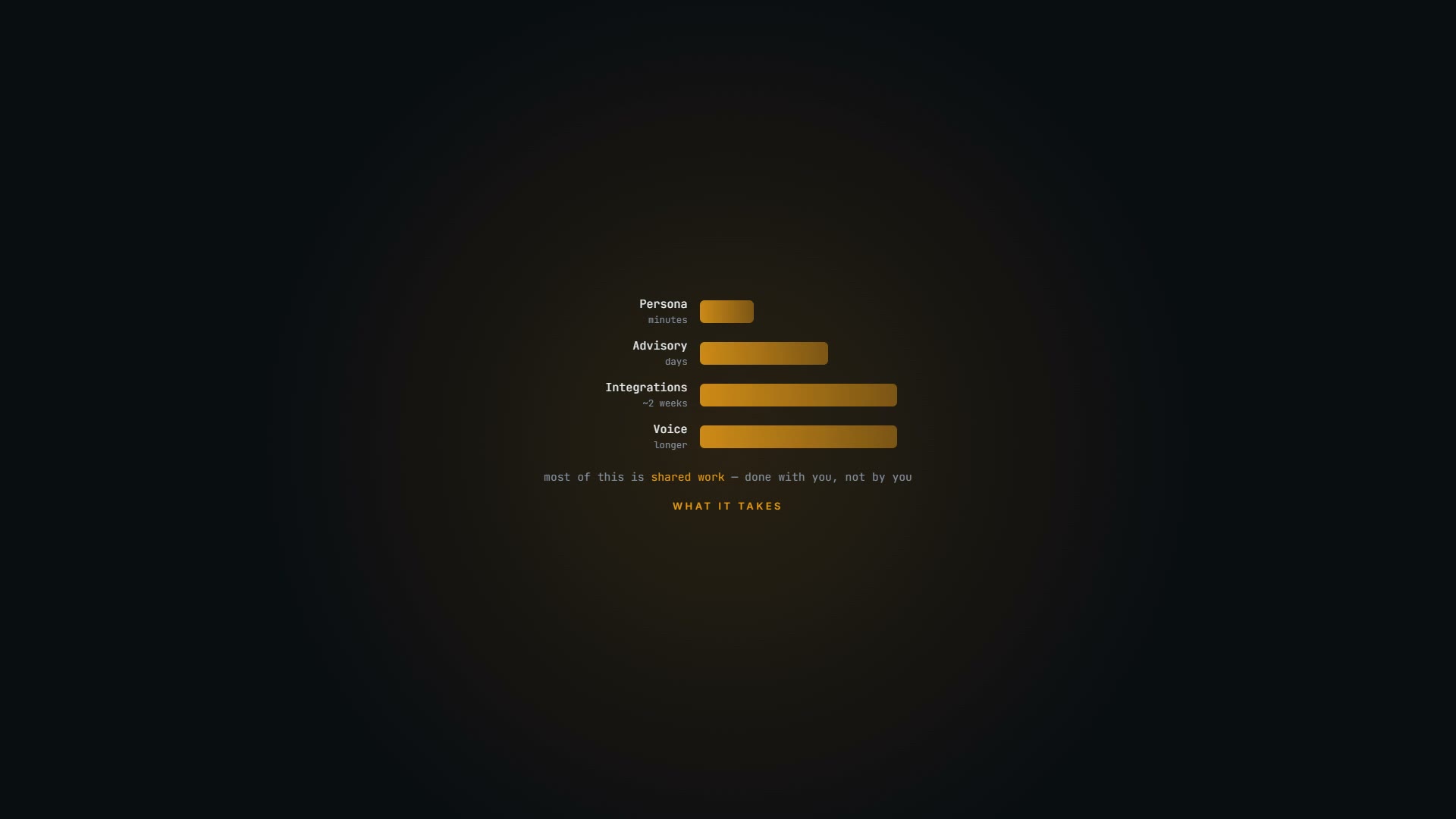
How to onboard — bringing a persona aboard, start to finish. About two minutes.
Who reviews what, where the gates are, and what "good" looks like.
Controls made consistent with your industry's standards and rules.
Built with industry knowledge, then loaded with your policies.
Every step logged; humans stay accountable and sign off on the exact bytes.
In the records-heavy practices — a Social Security disability matter, say — "trust the AI" isn't good enough. There, the deterministic rules run before any model, evidence is never summarized by a model, the release gate is code rather than an agent, and every assertion clicks back to its source page. See how that pipeline is built on the Tyr practice page →